


Skip to next section if you already know how to play.
Resistance is a social deduction game of imperfect information. Although the game can be played with 5-10 players, I am going to focus on the 5-player game in this essay. In a 5-player game there are two spies (red players) and three resistance members (blue players). The red team are aware of each others’ identities, while the blue team members have no information other than their own identity.
The game beings with a randomly assigned captain who must select two players to go on the first mission. All players vote to approve/reject the proposed team. If the majority of players approve, the mission’s player composition is accepted. If the majority of players reject, the captain marker moves clockwise and the mission marker is moved down the track. Until it gets to the 5th missions proposal.
In our game, we don’t even have a vote for the 5th mission, we simply let the captain pick his team and auto-approve it. There is 100% no reason for blue players to reject this mission and it only leaves the door open to game-ruining blunders, so we just skip the voting. We call the captain of this last mission “the hammer.”
If the 5th mission proposal is rejected, the red players win the the entire game. That essentially means the 5th proposed player composition must be approved.

Before we even begin this analysis, I want to mention the caveat that resistance is a social deduction game and much of the game is about reading your opponents. Obviously every playgroup and dynamic is different and it is pretty fruitless to discuss tells, since they are unique. If you have a sick read on someone:
Danny always tweets a photo of his role card when he is a spy!
By all means use that information and disregard any of my advice. Reads and tells are a thing in the game, but I am assuming you are playing with poker-faced pros and you only have logic go on.
After playing over a hundred games of Resistance with many different playgroups (and consulting with many other player groups, as well as discussing this topic at length on BoardGameGeek) I have noticed the same metagame develop multiple times. Here is how the game ends up looking with advanced players:
The first captain selects himself and any other player. All players except the two on the mission vote reject. The captain marker passes, the captain chooses himself and another player. All players except the two on the mission vote reject.
This process repeats until it gets to the hammer, at which point whoever is captain chooses another player and that mission is automatically approved. The key takeaways are that this process is completely automatic, everyone always rejects each mission they are not on, and you can gain some minor information from who leaders select “randomly.”
However the more developed and automatic this meta gets, the less information there is to gain from who the captain chooses.
This meta tends to evolve on its own after a seed begins to lay roots in observant players’ minds. When they finally ask the question,
“Why would you approve a mission you are not on?”
Analyzing why people act the way they do is the core gameplay in Resistance, and asking people why they are acting a certain way is one of the only ways to gain information. So why do they approve a mission they aren’t on? They will say things like,
“I just had a good feeling”
“I just wanted to see what would happen”
“I wanted to keep the game moving.”
However, after multiple games something else becomes apparent…
Who has an incentive to approve a mission they are not on? Red players. If a red player is on the proposed mission, the 2nd red player knows that and has a very strong incentive to approve and send this mission. Either so the red friend can fail it, or gain trust. Both good outcomes.
A blue player, on the other hand, has no incentive whatsoever to send a mission they are not on. Blue players have no information on the first mission other than the fact that they are blue. If a blue player ends up on a mission and that mission fails, then they get to be 100% sure the mission’s other participant was red. Until then, up-voting random missions can only hurt you.
Why does it hurt you? Because if good players sometimes approve missions for no good reason (or the above stated reasons) it gives red players an angle to do exactly that.
Imagine a world in which all blue players never approve missions and red players still do. Now each time anyone approves a mission everyone knows they are a red player! Sure, they are going to claim they are blue and they are just “trying to see what happens” but everyone knows it’s a lie because no blue player will ever approve. This is what blue players want, not to give the reds an opportunity to hide.
You might have heard, or even considered, the following counter-argument. Shouldn’t a player mix up his play when they are blue in order to increase their chances when they are red? The answer is no, you should always optimize your play to maximize blue victory. You are a blue player 60% of the time and a red player only 40% of the time. Hurting your chances (and all blue players chances) by playing sub-optimally 60% of the time to give your team an edge the other 40% is not a good idea if you care about your win rate.
Basically I am suggesting that for optimal rational play, the blue players should want the 5th leader to simply declare the mission. Let the hammer decide. Not sure why letting it go to the hammer is better than approving any random team? Well before we get into the numbers, remember if you approve you aren’t JUST sending a random team, you are making yourself look like a spy and damaging your reputation. That should be enough, but if you want numbers…
If you are on a mission, and you are blue, that means the other person on the mission with you is going to be red 50% of the time. Other than you, there are two blue and two red players left, and from that pool of players you are on a mission with one of them. This is as good as it’s going to get for blue players on mission one, a 50% shot to get a clean mission.
On the other hand, if you are sitting out and two other players are going on the mission, there is going to be at least 1 red player on it 5/6 of the time! Think about all the possible combinations of 2 red and 2 blue:
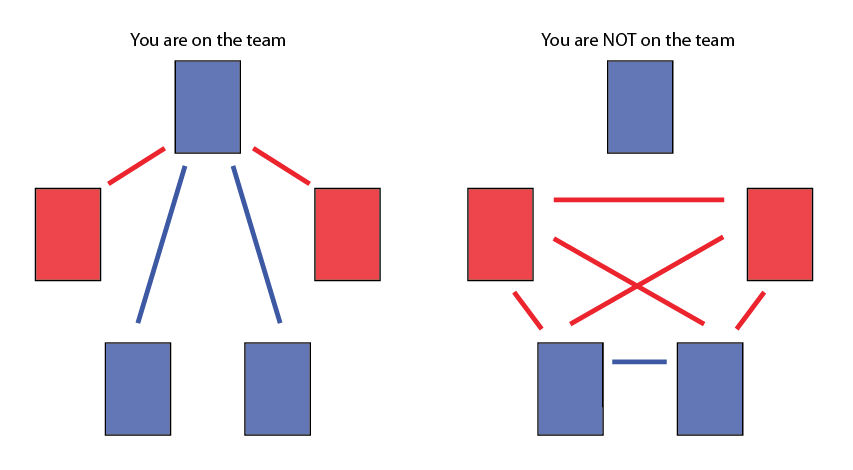
That means if you are not on a mission as a blue player there is an 84% chance the mission is dirty and only a 16% chance that it is clean. You don’t want to approve that! You being on the team increases the likelihood of a clean team from 16% to 50%.
Always reject if you are on the sidelines! You need to be on the mission. (Of course just because a dirty team goes on the mission certainly doesn’t mean this mission will be a fail, but what happens beyond this vote is not in scope here. We are focusing on not sending dirty missions.)
The inevitable conclusion of all this rejecting is going to the hammer. The logic here is pretty simple: you know who the hammer is going to be. If the hammer is you, well we know how that shakes out. You have a 50% chance to making a clean team.
If the hammer is not you… 50% of the time the hammer leader will be another blue player, and 50% of those times they will select a blue player (including you) giving this team a 25% chance to be clean. This is actually better than a team that is guaranteed not to have you on it, which is only a 16% chance to be clean. A completely random team is actually good for the blue players. To put it into simpler terms, a new team with the potential to have you on it is better than a team that doesn’t have you on it.
The sad truth is that if everyone understands this, and everyone decides to play optimally, mission one is a pretty trivial and boring experience. Many people have said, “Shouldn’t we just fast forward to the hammer and go from there?” I can’t say that is a bad idea, as you will save yourselves a little time. We still haven’t started doing this yet in our games preferring instead to have a rather stale robotic experience just in case something weird happens.
I have heard the argument made that it is still worth it for good players to “mix it up” because they can fish reads from the red players. The thinking is, since the red players have an incentive to point out this player breaking convention to make the other players mistrust. Once the accusations start flying a talented player might be able to determine which players are spies.
The major problem with this is even if you are insane at reads, and you 100% identify one of the spies, you will likely never be able to convince the others. PARTICULARLY if mission one actually fails. You will certainly look like a red player. (Conversely, if you are a red player on a mission which is approved by an outside blue player… THROW THE FAIL. The blue team will probably never recover.)
Don’t get me wrong. This game is still a blast after the game starts rolling on mission two. Also many expansions break up this meta a little bit because they give players different incentives. For example in the commander/assassin or Avalon variation of the game one of the blue players, the Commander, knows who both the spies are. This blue player can up vote missions they are not on because they may know for sure that a mission is clean (probably not a good idea since this makes you very easy to assassinate but it’s something to think about). The reverser module is also interesting and has the potential to mix things up though I haven’t fully explored it yet. Also consider the plot thickens which adds some variety by giving the leader a variety of changing plot cards to hand out.



I am not going to beat around the bush. This is a very bad game compared to the previous Mass Effect entries. There are glaring design problems that are completely inexcusable from a team of this caliber. Make sure to watch my first impressions video below in which I go over most of these problems. No I am not going to harp on the shitty facial animations. That is NOTHING compared to the real design and technical problems. Much time has passed since my first impression and now I am ready to give you guys some more.
Gladly, I can say with no fanboyism, that there is plenty of fun to be had while playing Mass Effect Andromeda. The problem is the game is riddled with fun-sucking landmines which you need to avoid in order to reach the fun. You heard that right, Mass Effect Andromeda doesn’t just lack fun, it actively attempts to ruin your experience through very backward gameplay design. Here are three great examples of BioWare “admitting” to and fixing horrible design choices:
Anyway. Here is the best advice I can give you for maximizing your enjoyment of the game. Spoiler Free.
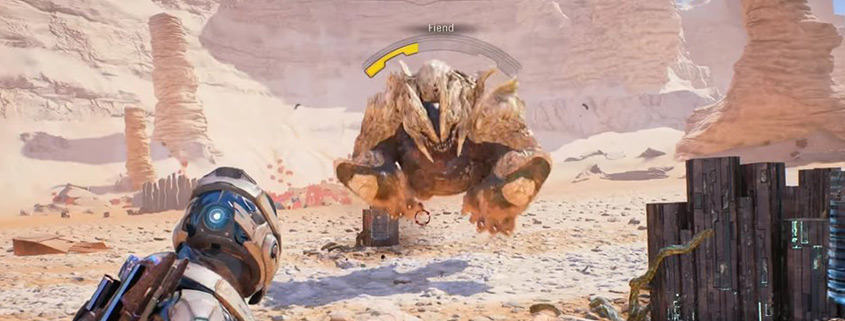
The start of the game is nearly impossible and frustrating… But I did it to myself. I asked for hard, I got it. I’m not mad, however there is CERTAINLY a problem with how the game scales early.
Once you get out of the prologue the trouble really starts. At least half the game’s combat takes place on hazard planets. This means you have a life support meter that depletes while you are exposed to radiation/cold/heat/cancer. The fights on insanity last SO LONG that it is very likely you will need to retreat just to replenish your life support. This involves sitting in your car for 5 minutes to get it back… Yawn. On some battles I had to go back to my car SEVERAL TIMES just to get my life support back.
Then you have to contend with the auto save system, which is spotty at best. You probably expect to die a lot on insanity. But do you expect to die 3 minutes travel time from the battle? Because that is going to happen. Getting burned out early from the frustrating combat is pretty much guaranteed.
It is important to point out that the achievement for beating the game on insanity can be claimed either by beating the game on insanity, or extracting on gold difficulty four times in multiplayer. If you plan on going hard on multiplayer, this achievement is pretty meaningless.
I would encourage you to start on hardcore if you are seeking a challenge and go from there.
This game primarily takes place on 5 planets, the Golden Worlds. If you want to avoid frustration it is important to save the bad/annoying planets for last. They are much easier to manage when you have better skills, armor, guns, car and experience. Here are all of the planets from most fun to least fun:
The first planet you explore is Eos. You will notice that I put Eos second to last… A mind-boggling choice for the player’s first experience with open world travel. Suffer through this shit planet and soon you will get the choice to go to Havarl or Voeld.
This is the most important decision you will make in this game. Make sure to go to Havarl first. Because if you go to Voeld first there is a 10% chance you are going to break your fucking console, and a 100% chance that you want to play a different game. Once you harvest Havarl for all of its goods and deck out your car you should be able to handle any planet you want. But I recommend you use my order.

When you start settling planets, you get to wake people up from cryo sleep. You are given a long list of groups to wake up and they give you various rewards. It’s pretty overwhelming at first and you might be temped to get something like cash or minerals.
The first one you want to do is the one which reveals hidden caches. It puts treasure chest indicators on the map on all the planets you are going to go to for the rest of the game. These chests are full of plenty of good loot like guns, armor, consumables, and rare materials (remnant cores). Your life much easier, and you will have more fun. It has considerably more value than the other pods, and it will make your exploration experience better. You will unlock around 20 total pods over the course of the game so don’t worry about missing something.
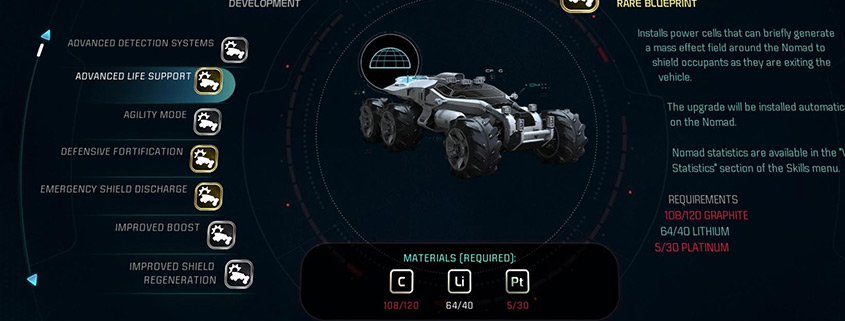
You are going to spend a ton of time in your car driving around mountainous hazardous planets in this game. You want to make this experience as easy as possible so you can have fun actually doing your various quests. Giving the car all of these upgrades will ensure you can travel over hills and jump-boost over gaps without worry. Getting to where you want quickly is very helpful.
Additionally, because of the horrible design of open-world encounters, your car is going to be your sole source of cover for many battles. This is why some of the defensive upgrades are also helpful, especially advanced life support.
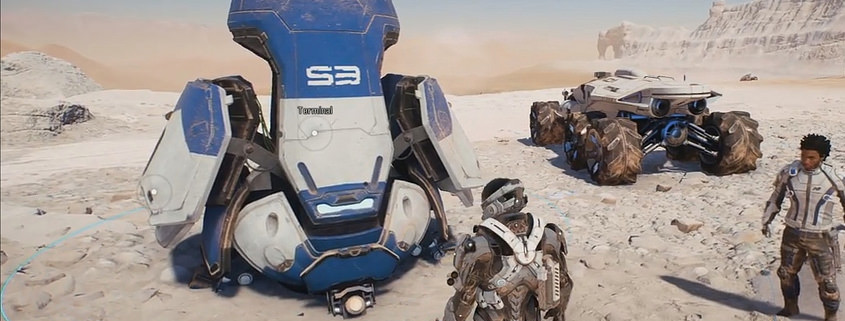
Speaking of making travel easy, here is a tip I didn’t fully realize until halfway through the game. When looking at your map on planets you will see these icons resembling a lunar lander. These are forward stations, they provide a safe environment for you to: go back your the Tempest, change squad mates, change load outs and call your car. What I didn’t know for a long time is that clicking on an active forward station FROM the map allows you to fast travel to it!
The first thing you should do when coming to a new planet is immediately zig zag to all of the forward stations. Then you can teleport to any location on the planets without wasting time driving around and running into stupid Kett dropships at every mile marker. This will probably shave 10+ hours off your gametime.
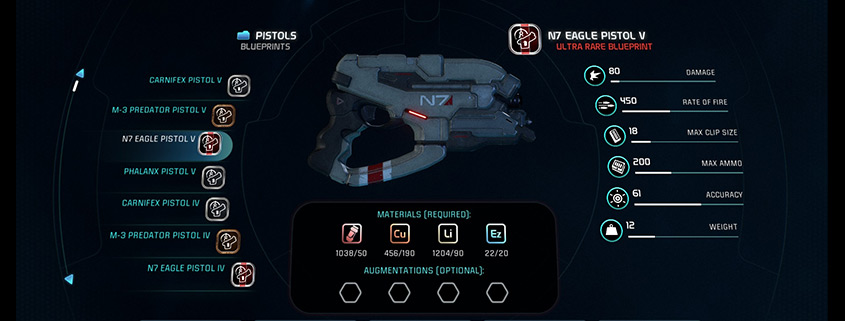
Those are just some of the reason you shouldn’t worry about it until you are good and comfortable. No sense pulling your hair out dealing with the crafting interface just to make a gun you are only going to use for a few missions. A much better idea is to collect junk while experimenting with all the guns you find. Around level 25-35 you will start to understand what you need, at which point you will have enough augmentations, materials and research points to deck yourself out.

This game can boast being a 100+ hour game, but 80% of that is not gameplay they should be proud of. All of the fun is hidden inside the story-progressing missions and loyalty missions. The loyalty missions also unlock the 6th rank of your squadmates’ abilities. This makes them better in combat, which makes combat more fun for you.
When you start moving forward into the game you will see like 25 quest indicators on a planet! Look at all these amazing missions! Don’t kid yourself, they are almost all complete garbage, and it’s actually hard to tell what is real and what is a useless waste of time. Learn to navigate your journal and pick out the important stuff before you find yourself 25 hours deep with nothing to show for it.


Do you guys watch Star Trek TNG? Of course you do. Well hopefully you will remember this episode called Conundrum as well as I do. The is the historic episode in which Data is defeated in chess (3D chess) by Deanna Troi. I remember seeing this when I was in middle school and kinda scoffing… Yeah right as if she could ever beat Data. Data seems surprised that she devised a completely “new” strategy to an already well-researched sequence of moves. Troi explained that chess is a game of intuition… (Something Data’s programming cannot provide.)
I revisited by episode again when I was in college as I was watching the show again, and I was completely APPALLED! Humans can’t even beat computers now (Circa 2006), and Data is a million times more sophisticated then today’s machines. What are they trying to do in this stupid episode!? Suggest that Troi is better at chess than the most powerful computer in the universe (arguably)? Surely chess will be completely solved by then, don’t these writers know anything? Didn’t the scientists on staff who help with the script know anything!?
I must admit, later I found out that solving chess isn’t as easy as I originally thought. It isn’t simply a matter of time, there truly are more possible game-states than atoms in the universe.
Let’s take a short detour to really analyze why it might be impossible to solve chess. If you watch the Numberphile video you will see the mention of Shannon’s number, which although is pretty simplistic is most well known estimate for the complexity of chess. Shannon theorized that there are 10^120 possible different games of chess. Scientists estimate that the entire known universe “only” contains 10^80 atoms. This means if we assign one chess game per atom, we will not have enough to contain them all!
For a computer, storage space would be the first problem. As of 2012 it takes 1 million atoms to store a single bit of information. Let’s say someday we get that down to one atom per bit. Even if we could store an entire game of chess in a single bit (a bit only stores a 0 or a 1) we would need to harvest every atom in the universe and still not be able to create a large enough hard drive.
But what if we could! Well if you take every atom in the universe and put it into a line, that line would be 10^70 meters long (diameter of an atom is 0.1 nanometer). Traveling at the speed of light, it would take 10^54 years to travel from one end of this line of atoms to the other. That means if a computer wanted to access all of these bits of data just a single time, that is how long it would take the computer just to travel to each bit, let alone access it. (Thanks to @FreddyZ for the math help.)
So maybe it isn’t THAT obvious that Data should win. But he still should right? Troi has never been recognized as an exceptional chess player, or any kind of strategist at all. I suppose she would be stronger than your average human given her empathic abilities, perhaps being able to read the next move but Data is immune to such nonsense.
During the Alpha Go vs Lee Sedol Go match it finally dawned on me! Computers weren’t always so amazing at chess! I need to check the dates:
This episode originally aired in 1992. Deep Blue didn’t defeat Kasperov until 1996! The writers (and scientists) at the time were probably working on the assumption that computers will never be better than humans at chess. They probably tried to look it up too, and the only thing they found was Shannon’s Number (more games than atoms in the universe) and concluded, because computers can’t brute-force chess, they can never beat the best human players.
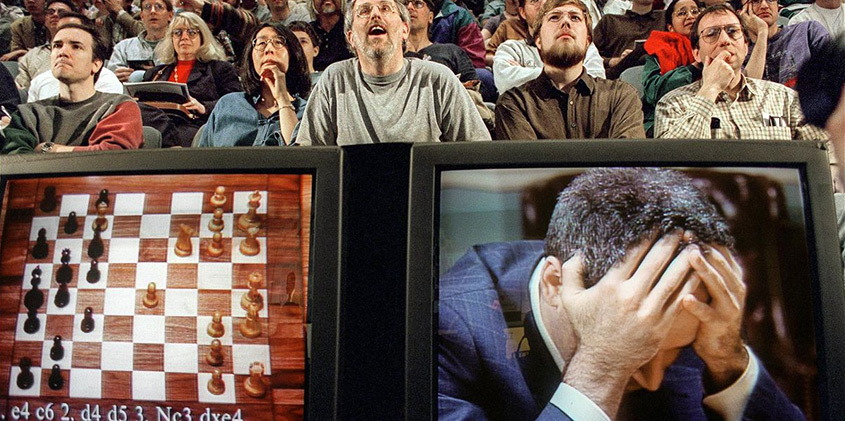
I still think it was pretty bad writing, because during the scene Data lists the correct named response to his named attack. If his attack, and resulting defense are both named move sequences then they have been well studied, surely Data would know the entire “book” on both maneuvers. Which means he would not be surprised by any defense. Even if it was not what he anticipated. But he reported the correct response to his attack, which means that must be the BEST defense. Obviously it isn’t if Troi completely countered the defense and set up Checkmate in the next few moves, that doesn’t make sense. Also, Data clearly puts Troi in check, but she does NOT move her king out of check. In the next move Data can simply capture her king. I suppose the rules of 3D chess are never canonically explained, so I guess we need to accept that “checking the king” doesn’t actually mean anything in this game?

Oh well, I suppose suspension of disbelief should ease my mind of this. The idea that computers lack “intuition” and 3D chess is more complicated than regular chess in some strange way are probably enough voodoo science fiction to make it possible for Troi to win. But it is very interesting for me to get into the mind of the writers at the time and really wonder what they were thinking when they wrote this scene.


